
Multi-Protocol, Cross-System Integration Solution
Introduction
Most plant managers aim to reduce time-to-market and improve productivity, but they often hesitate due to the high cost and complexity of upgrading or replacing existing systems.
With Lanware’s multi-protocol, cross-system integration solutions, manufacturers can smoothly transition from legacy infrastructure to modern digital systems with minimal downtime and maximum flexibility.
Challenge
As manufacturing operations scale across multiple facilities, improving operational efficiency becomes increasingly challenging.
Factories typically rely on multiple complex systems to manage:
- Production scheduling
- Inventory
- Quality control
- Equipment monitoring
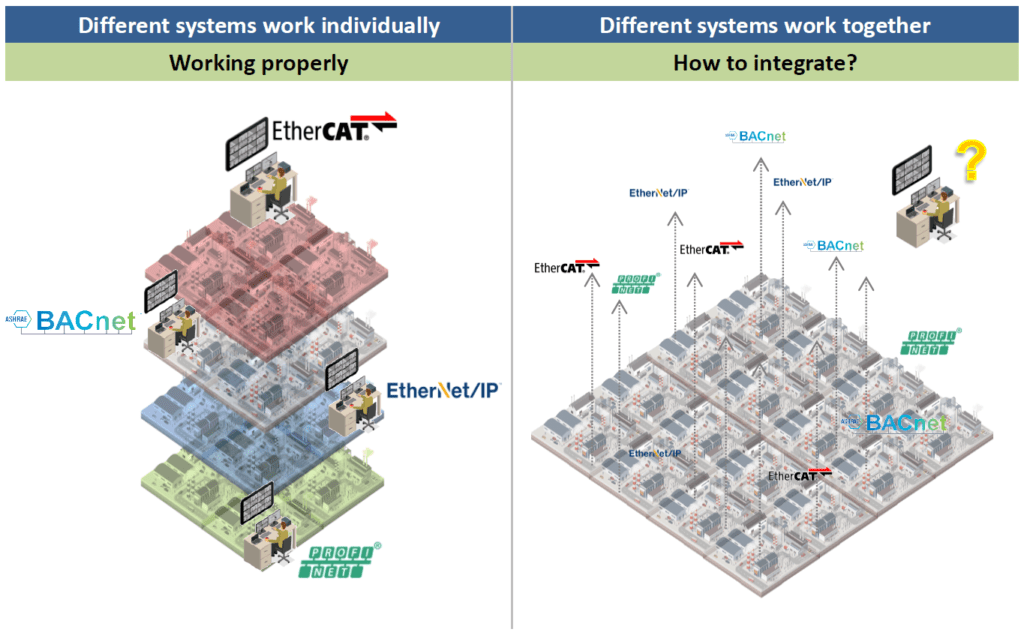
When operations are spread across different locations, centralized monitoring and data sharing become difficult. Manufacturers need a simple, efficient solution to unify systems and gain real-time visibility across all plants.
The Lanware Solution
By implementing Lanware’s industrial IoT integration platform, manufacturers can achieve:
- Cross-system integration
- Unified monitoring interface
- Protocol conversion across devices
- Real-time data acquisition
- Centralized visualization and control
This enables plant managers to ensure consistent product quality, optimize operations, and reduce costs.
Features, Advantages, and Benefits
1. Data Acquisition
Modern factories consist of multiple production floors, machines, and sensors generating large volumes of data.
Lanware provides Industrial Ethernet I/O modules that support:
- Analog and digital inputs/outputs
- Real-time data acquisition
- Local automation and control
These modules can operate independently or as part of a larger system, enabling efficient monitoring and control of equipment.
To address protocol diversity, Lanware multi-protocol gateways convert communication standards such as:
- Modbus RTU/TCP
- EtherNet/IP
- EtherCAT
- PROFINET
- BACnet
This ensures seamless integration between devices using different protocols, improving system interoperability and simplifying future upgrades.
Additionally, this approach reduces the need for complex PLC reprogramming, saving both time and operational costs.
2. Communication
Lanware ensures reliable and high-speed data transmission through:
- Industrial Ethernet switches for stable wired communication
- Wireless and cellular routers for remote connectivity
These solutions support:
- High-speed data transfer
- Network redundancy
- Flexible deployment
- Secure connectivity between distributed systems
With improved communication infrastructure, plant personnel can focus less on maintenance and more on optimization, predictive maintenance, and system performance.
3. Management
Lanware offers advanced industrial software platforms for centralized monitoring and control:
- Network Management Systems (NMS) for monitoring all connected devices
- SCADA platforms for automation and process control
These platforms provide:
- Real-time system visibility
- Remote access and control
- User-friendly dashboards
- Simplified operation with minimal training
This improves decision-making, enhances transparency, and streamlines plant operations.
Conclusion
As manufacturing operations grow and evolve, adopting flexible and scalable digital solutions becomes essential.
Lanware’s cross-system integration and industrial IoT solutions enable manufacturers to modernize their infrastructure without disrupting existing operations. By ensuring compatibility, scalability, and efficiency, Lanware helps businesses stay competitive and future-ready.